Freeride backcountry skis
Product 2027
Woman, Man
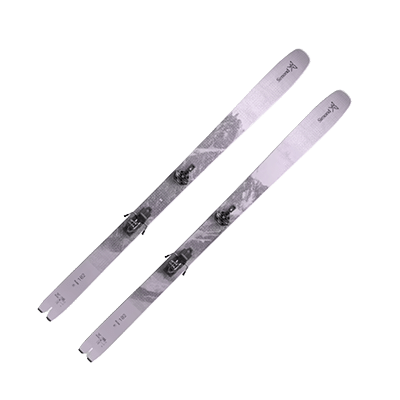
Essai de la deuxième paire 2027 d’un ski Simond Wilder 102. Il a été testé en 185 cm. Il a un rayon de 22. Il possède une sorte de queue d’hirondelle sur l’arrière. Une spatule effilée, du rocker devant et derrière, une longueur de carre minime.
Test of the second 2027 ski model from Simond, the Wilder 102, evaluated in the 185 cm length. It features a 22-meter radius, a swallowtail-style tail, a tapered tip, front and rear rocker, and a minimal effective edge length.
The Simond Wilder 102 sports a mauve graphic with a minimalist dot pattern. Construction quality is quite solid overall,backed by a durable topsheet that holds up well against wear.
On the skin track, it feels light and tracks easily, saving your energy on the ascent. However, edge grip during side-hill traverses on hard snow is less than convincing, taking a bite out of confidence. It is best kept to softer snowpack. Overall,the ski struck us as somewhat unbalanced: it pairs a wide footprint with an ultra-light build and pronounced rocker. As a result, hard-snow hold and edge bite suffer, since the effective edge length in contact with the snow is extremely short.
The Simond Wilder 102 is heavily oversteering. The tail provides very little support, causing the ski to pivot almost instantly if driven from a centered or slightly backseat stance. You have to stay actively forward, driving through the boot tongues, to restore balance. Consequently, the Simond Wilder 102 targets skiers with solid balance and precise weight distribution. For anyone else, the slightest backseat slip causes the tail to wash out, forcing quick corrections to keep the ski under control. And because edge grip is limited, coming across icy patches will quickly catch even strong skiers off guard.
Building up confidence on edge is tough unless you are in soft snow. On hardpack, carving a clean turn becomes exceedingly tricky. When you need dependable edge hold—such as dropping into a steep couloir—that kind of hesitation is far from ideal. You have to constantly manage a soft, elusive tail that makes pivoting effortless but lacks the support needed for a solid, reassuring platform.
Paradoxically, despite the pronounced tip rocker, the forebody causes fewer issues. That said, forebody chatter is significant, cutting into confidence as speeds increase.
This raises the question: why combine a wide, ultralight chassis with such aggressive rocker? Trimming back the rocker might yield more effective edge and better stability—unless the issue stems from torsional rigidity.
For the ski tourer seeking powder or chopped-up snow, it performs very well, floating over obstacles effortlessly and pivoting on a dime. It is undeniably an easy, pleasant ski in those conditions. However, avoid pairing the Simond Wilder 102 with a heavy backpack: any backward pull will amplify the weak, underpowered feel of the tail. Note that it is offered in only two sizes. Supplied with bindings and skins!
While the Simond Wilder 102 looked promising on paper, its tail behavior on hard snow is quite unsettling. We far prefer Simond’s other touring model, the 95, which feels much more accomplished.



We used this equipment over a long period of time
These are our thoughts after intensive use:
Receive your answers by mail. Do you have a particular question concerning the design, use, durability or other about a tested product? We will answer your question personally.